Showing posts with label for-profit malware. Show all posts

Thursday, August 28, 2014

Tracking Mobile Malware Groups at Google

I ran across this opportunity at Google: Analyst, Android Security
https://www.google.com/about/careers/search#!t=jo&jid=66345001&

It piques my interest as one of the stated goals of the job is "[becoming] an expert in the workings of mobile malware campaigns".  A few years ago(2011) I was able to momentarily take a step back from analyzing individual samples to take a look at the state of mobile malware and how criminals and their networks profit.

The 'Mobile App Moolah' presentation was based off a number of years of data we had amassed on malware sources(e.g. geography and authors) as well as intelligence shared between other Antivirus researchers.  My strengths lay in analyzing the samples, identifying characteristics that would hint at possible origins and apparent motives of malware authors.  Other colleagues provided insight on how malware authors and organized crime set up infrastructure(i.e. monetization methods, advertising, acquisition of targets) for  turning what used to be a hobby into profitable enterprises.

Mobile App Moolah - How malware authors and criminals profit


From the collection of metadata I had on in the wild samples I could see how criminals operated in two large geographical regions; for ease of reference, Russian and Chinese speaking regions.  Based off of the code we were seeing the Russian zone employed simpler(though still highly successful) attacks and the Chinese zone using complex and multistage attacks.

I still had only half the picture. I could see the tactics used against victims on their smartphones, but the shared intelligence on crime networks filled in the rest. With Russian SMS sending trojans the profit turned on having easy access to vendors that provided relatively anonymous Premium Rate SMS short codes("Text 'Ring' to 12345 for the latest ringtones"). The ability to acquire a short code quickly and run a campaign(paid for by unaware victims through mobile billing) made it difficult for the perpetrators to get caught while still earning a return on their investment in developing the malware.

The Chinese attacks were complex with anti-evasion and encrypted Command and Control(C&C) channels, due mainly to competition. Competition equally from Security/Antivirus vendors and from rival organized crime. While one could easily steal 1 Yuan from a million victims and net a profit, keeping your enemies from hijacking your mobile botnet still requires a larger R&D investment(e.g. code protection, encryption, etc). The back end, or how the criminals profited also varied. Personally Identifiable Information(PII) and various chat accounts with associated wallets provided alternate streams of income versus Premium Rate SMS fraud.  Organized crime provided multiple service providers to facilitate the passage of virtual funds(QQ coins) to physical/electronic money. Resellers and fences add value to stolen data(social network accounts, credit card numbers).

This Google position appeals as they have access to a significantly larger pool of data on both malware developers and sources for malware. The first step to having victims find your new mobile malware tends to involve Google(i.e. the Play store, Google ads, getting indexed by Google, etc.). Never mind that the Android Security Team receives intelligence, samples and Proof of Concepts from researchers and the public. Whoever eventually gets the role will get some amazing insight into the Android malware underground.
----------------------

If one is interested, a video of the 'Mobile Moolah Presentation' and the slides are available. The geographic portion starts at 4:17, the 'How they profit' portion starts at 6:27.

Tuesday, March 08, 2011

Google Tool Cleans Up Mobile Malware ‘Dream’


Over the weekend Google released the Android Market Security Tool to help clean up  devices infected with the DroidDream malware. The Android/DrdDream family of malware used a pair of exploits (Expoit/LVedu and Exploit/DiutesEx) to gain root access on vulnerable Android devices.  More than 50 Android applications were reported to be infected; all were pulled from the Android Market. The applications were all versions of legitimate programs that were repackaged by the malware authors with malicious code.

Android/DrdDream sends a collection of information (IMEI, IMSI, OS version, etc.) to the attacker and also attempts to download additional payloads. Although the malware uses the pair of root exploits, it doesn’t actually need root access to send the data to the attacker.

Inside the Android Market Security Tool

Google has its official statement on the the tool on the Android Market help site. They list a number of steps they’ve taken to remedy Android/DrdDream (“March 2011 Security Issue”):

  • Suspending the developer accounts (three users) and removing the malicious applications from Android Market
  • Remotely uninstalling the malicious apps from infected devices
  • Pushing out the Android Market Security Tool to infected devices

Disabling accounts, taking apps out of the store, and hitting the remote-app kill switch were already well known ways for handling bad Android apps. Sending a security application to a phone is a whole new addition to the toolbox.

As a security researcher I find it interesting to see how new security tools are put together, more so when they come from an operating system developer. Normally I dig into the internals of malware; this time I got to see inside a mobile malware removal tool. Google’s security tool is available on the Android Market, so I was able to grab a copy for analysis.

The Android Market Security Tool is an Android app that also has a non-Dalvik native application component called droidreamclean. Android/DrdDream drops a few additional files (native binaries, an additional APK, etc.) on an infected phone. Because the files are located outside of the app directory, simply uninstalling the app won’t remove them from the phone. Really cleaning the phone requires access to the file system at a level that standard Android applications can’t reach. The security app  launches droiddreamclean to delete the additional files and restore some security settings.


The droiddeamclean binary deletes the second payload, DownloadProvidersManager.apk, downloaded by the Android/DrdDream malware. This prevents the malware from downloading additional malware or updates to the device.


After it gains root access, Android/DrdDream attempts to copy a second payload from its assets directory to the application directory (/system/apps/DownloadProviderManager.apk). This is a manual installation that completely bypasses the Android Market and because the Market doesn’t record the installation, it can’t be remotely killed. droiddreamclean doesn’t have this problem and instead tries a couple of uninstallation methods: using the “pm” package manager or manually deleting the APK.

The malware copies a renamed “su” executable (/system/bin/profile) to a directory of other system commands. This allows the attacker or updated malware to gain root access in the future. The Security Tool gives that executable the same treatment as the downloader component of Android/DrdDream.

In case the remote kill does not work, the security tool includes a list of apps that are removed using the command-line package manager. The Android/DrdDream authors definitely are not going to be able to slip one through.


A selection of the 58 packages removed by the Android Market Security Tool.

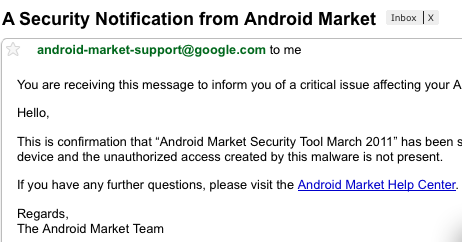
After droiddreamclean finishes, the Android Market Security Tool informs Google that your phone is now clean. It then uninstalls itself. At the end of all this, you get an email from Google telling you that it has removed the malware and that no issues remain.

Google informs you after the Android Market Security Tool finishes cleaning your phone.

Is the Android Market Security Tool enough?

The Android Market Security Tool is a pretty comprehensive tool, but it’s really designed only to clean up Android/DrdDream and its side effects. The tool itself doesn’t patch or reflash the operating system, so the vulnerabilities exploited by Android/DrdDream will remain. Updating the operating system will require help from the manufacturers of the various affected Android devices.

For similar infections, Google might have to follow the route that other security software takes and provide regular updates. The creation of the security tool and the work put into handling the Android/DrdDream issue shows that Google understands the need for mobile security software.

Monday, February 28, 2011

"Write Once, Mobile Malware Anywhere"

from McAfee blog:
"The Zeus (Zbot) crimeware is sold to criminals as a complete toolkit for building custom Trojans, usually to steal banking logins.  The Trojans are generally quite complex; injecting HTML into banking websites on the Internet Explorer and Firefox web browsers, intercepting keystrokes, and grabbing screenshots.  Until a few months ago the Zeus infrastructure targeted only Windows PCs, but the adoption of certain security measures (mTANs sent via SMS) used by some banks caused the criminals to change their tactics.

SymbOS/Zitmo.A was a mobile spyware application used to intercept and forward the mTAN SMS messages sent from an infected user’s bank to an attacker.  This was implemented by the Zeus Trojan for gathering information from victims about their mobile phones so that it could send a targeted download link to them.  The attacker could then change what numbers were monitored by the spyware to go after specific banks.  This particular group of crooks was using SymbOS/Zitmo.A in a targeted attack against Spanish banks.  It was suspected that a Blackberry version of the spyware was also being distributed, but no samples have yet been found."
[...]

Mobile Malware Benefiting From Virtual Machines?
The people behind Zeus are now targeting at least two, if not three, of the major smartphone platforms.  Writing for one smartphone platform can be challenging, writing for multiple devices can be a bigger headache.  By writing a malicious app for the .Net Common Language Runtime(CLR) and Compact Framework, the Zeus authors might be trying to take advantage of coding for virtual machines (VMs).

There are a number of benefits of using VMs for the malware author:
  • maintaining compatibility
    • APIs on the VM will remain the same
  • code reuse
    • working parts of the malware (SMS sending, Bluetooth transfers, etc.) don’t need to be rewritten
  • affecting more devices/OS
    • malware can run on vastly different phones or devices
[...]


Alien Dalvik currently runs on a Nokia N900. Apps run at the same speed as on an Android phone with nearly identical specs. Credit: PRNewsFoto/Myriad Group AG

Given the availability of a common smartphone-based virtual machine (Dalvik on Android/Alien Dalvik on other OS) it would not surprise us if the Zeus authors eventually consolidated their mobile malware onto that single platform.  Instead of just “Angry Birds” one could also get the latest spyware or SMS Trojan.

Wednesday, December 06, 2006

"Want spies with that?"

From McAfee blog:

"We’ve received a sample of a new mobile malware in the MultiDropper family, variant CG. MultiDroppers are like a collection of top 10 hit songs, a ‘hits CD’. They also require about as much creativity. Take a successful hit like SymbOS/Cabir or SymbOS/Commwarrior, mix in a SymbOS/Appdisabler or SymbOS/Skulls.

The trouble with hits CDs is that you probably already own all the albums containing the hits. Maybe you get a bonus song now and then. In the same manner we already detect most of the malware in most mobile MultiDroppers. Every so often we do get the bonus unseen or rare single (malware).

MultiDropper.CG is the first in the series to include spyware, SymbOS/Mobispy.A."

[...]

"Although SymbOS/MultiDropper.CG does not appear likely to be a winner, it does signify a probable switch in malware authors’ goals. Rather than destroying your data and information, they’re stealing it for profit."

Monday, September 11, 2006

"Phone-y Money"

From McAfee blog:

"For-profit malware has been increasing on the PC side for quite a few years now. Viruses that hold your files hostage, trojans that steal banking information and adware that floods your computer with popup ads. Malware writers have shifted their goals from gaining notoriety or personal satisfaction from the spread of their creations to the goal of filling their wallets.

Recently though, McAfee Avert Labs has begun to see a similar trend in mobile malware. Most of the mobile malware that we’ve run across has been relatively harmless trojan horses. A few files have been replaced, or the phone fails to start when reboot. A hard reset to clear the phone memory and you’re back to normal, minus your stored phone numbers and calendar information. You might have lost any time spent adding new software or saved documents, but at least none of your private information has been stolen. J2ME/Redbrowser changed the entire situation."

[...]

"Stealing money in real life ranges from corporate embezzling to the common mugging. Where Redbrowser falls somewhere in between the two, J2ME/Wesber is closer to a mugging."

[...]

"With the recent SMiShing incidents, the rise in for-profit mobile malware is definitely troubling."

Protecting the ‘Metaverse ecosystem’…: Openness is healthy

Meta’s Reality Labs has an opening for “Malware Reverse Engineer” . Not an uncommon role, but this particular one is a bit more specific whe...